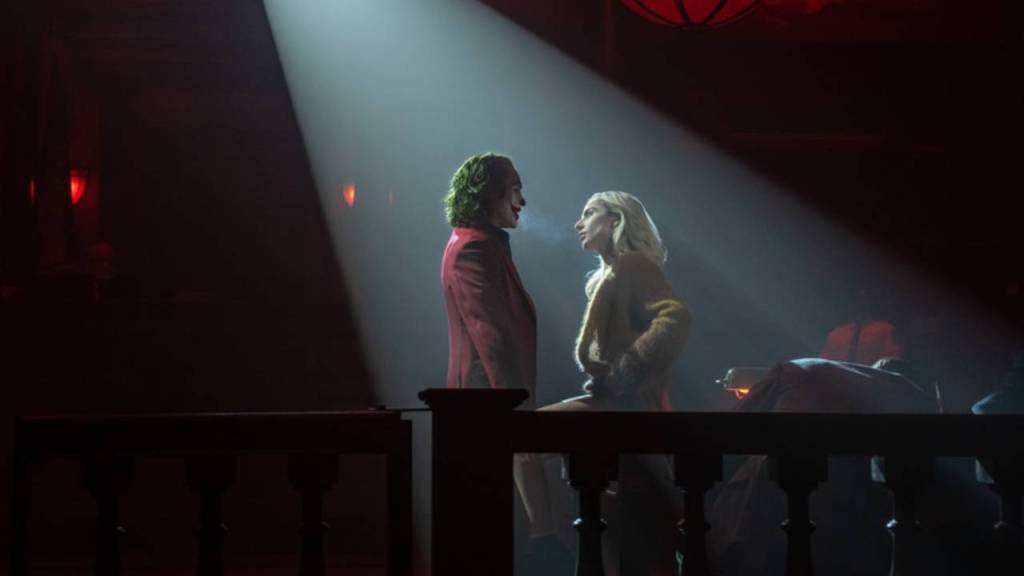
“You were the only one that was nice to me.”
When the Joker sequel was announced as a musical, I was more excited than most. It sounded like a fresh idea in an oversaturated genre with the ability to mask musical numbers as Joker’s insanity along with a perfect casting of Lady Gaga as the Harley Quinn character. What we received instead suffered from the same identity crisis as the titular character, pretending to be a brave concept but never committing. It feels like the film pauses to squeeze in uninspired musical numbers with only really one or two characters participating. To put it bluntly, the film is just boring.
Joker: Folie à Deux facades as something bold and stylistic but refuses to fully commit. It feels like viewing a beautifully abstract building from the outside, but once you enter, it’s just a dull, cubicle-filled office space. The main character, Arthur Fleck (Joaquin Phoenix), suffers from insanity and hallucinations, providing a perfect excuse to have elaborate musical numbers and dances. While the film does present a few of these as happening in Arthur’s head, a majority of the songs are one or two characters barely singing and canonically happening in the real world. These feel out of place and barely progress the story, rather opting to almost pause the movie to squeeze these in. If you’re going to be bold, go for it. This half-hearted attempt at a musical is more frustrating than if they just didn’t attempt it.
The performances in the movie are as good as they can be considering the poor script. The most disappointing miss of the film is the underutilization of Lady Gaga as Harley Quinn. We have a multi-platinum artist cast in a leading role in a musical, and yet they refuse to let her really sing. This is again because of these aforementioned commitment issues. Joaquin Phoenix is able to capture the same mystique that made the first film such a success, but it’s not enough. Perhaps the most enthralling performance of the film surprisingly comes from Leigh Gill reprising his role as Gary Puddles from Joker. With a minor role, Gill is able to give a heavily emotional performance identifying the trauma Puddles received from Arthur even though Arthur “spared” him. It’s frustrating to have all these great puzzle pieces come together into something so dull and uninspired.
For all the negatives, the film at least looks nice and wraps up in a fascinating way. The cinematography is well done and has some really gorgeous shots. The one place Joker: Folie à Deux is bold is the ending. Arthur is abused and comes to some realization that he isn’t what he’s been trying to be; he isn’t the Joker. When he admits he isn’t the Joker, everything seems to fall apart. Harley is no longer interested in him, he is a nobody at the prison again, and the movie ends with an unexpected conclusion. While I find this conclusion interesting, I can see how it would be unpopular. It’s unsatisfying and tears down most of what was built in the first film and the first two hours of this one.
I found Joker: Folie à Deux to be a fairly interesting character piece, but it really struggles with identity issues and committing to what it pretends to be. It’s barely a musical, and as a consequence, the potential of Lady Gaga in her leading role is heavily smothered. While it’s ironic the film struggles with the same issues as its titular character, this doesn’t come across as clever and is instead best summarized by the classic saying: I’m not mad; I’m just disappointed.
★★✬✩✩ 2.5/5

 Lorenzo C. Pompeo